why I dislike the term “silvopasture”

(I was writing another essay today and found myself going off on a rant about the term “silvopasture.” I decided to remove it from my essay and make it a new post…so here you go). 

For close to a decade of my life, I was either a student of forestry or a forester throughout the US and Germany.  I studied and worked in a variety of forested environments, and eventually made the transition from forestry to horticulture. The two realms, forestry and horticulture, originally came together for me was when I started learning about the lesser-known tree and plant species which produce medicinals and food within the forest and forest edge. I became quite good at foraging for food and medicinals while on the job and the idea of managing a piece of property for fruits and nuts became much more exciting to me than managing for timber. The transition from forester to horticulturalist began when I started to transition from forager to farmer; from forest to orchard.

An orchard is an intentional planting of trees or shrubs that is maintained for food production. Orchards comprise fruit, vegetable, and nut-producing trees which are grown for commercial production. Orchards are also sometimes a feature of large gardens, where they serve an aesthetic as well as a productive purpose.

Now on to this term: Silvopasture

Silva in latin means forest or woods. Pasture comes from the latin Pastura, meaning feeding or grazing. Together, you get grazing/feeding in forest or woods.

When I first heard the term “Silvopasture,” I assumed it was the act of thinning or planting a forest for timber/firewood and beef/pork/mutton/poultry, etc production. And in some cases, it is. But I have to address the other cases where silvopasture has become a term for planting fruit and nut trees on a pasture for some form of commercial fruit and nut production and introducing animals to the scene.

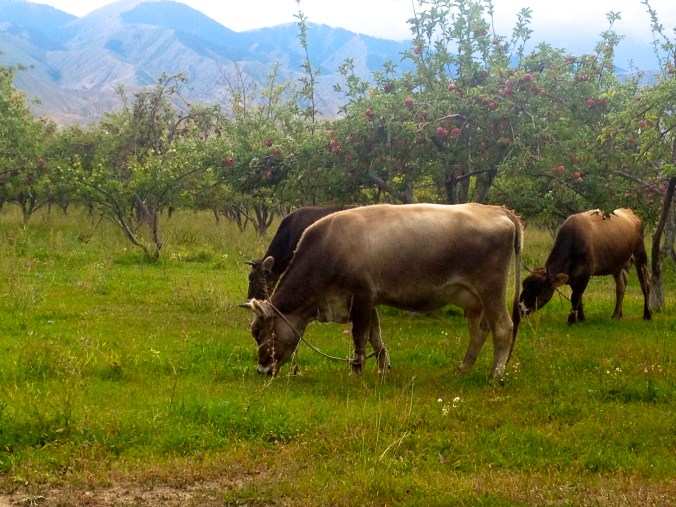
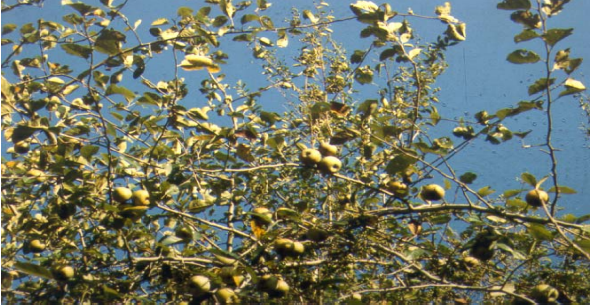
An intentional planting of fruit and nut trees is an orchard. For centuries, people have grazed their animals through their orchards because it makes complete and total sense on a practical level. Animals are an integral part of management in my opinion and weird health fears and scaling up are likely to blame for the elimination of grazing.  In the rest of the world, though, animals are still in orchards and it isn’t called silvopasture. Here’s a recent photo-example from Kyrgyzstan: A dwarf apple orchard with beasts in it.

IMG_0814

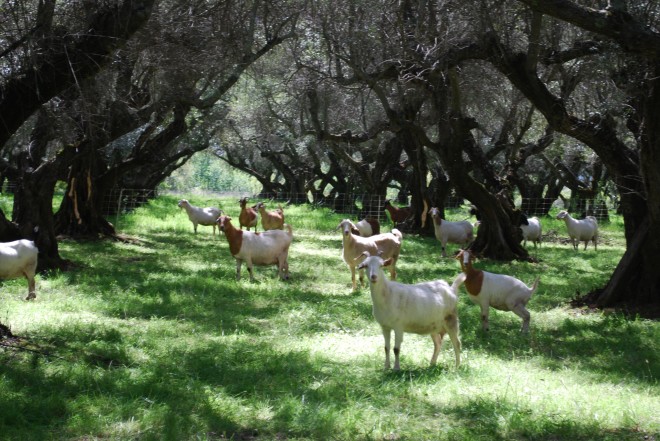
Or an olive orchard with goats in it in Northern Italy:

Both of these systems pictured manage for a tree crop and a meat crop (and grass crops). No timber will come out of these systems, and prunings take the place of coppice wood (which could be used as firewood). (Note to self: Pruning vs Coppicing is an interesting topic to revisit in a future essay).

How very American of us to first remove animals from orchards on account of scale and fear, and then put them back in and rename the system.  My dislike of the name silvopasture isn’t just in the semantics, though… This renaming thing we Americans do is directing people away from sources of valuable information. Information like how to grow these trees for tree crops on a moreso commercial scale is a practice studied in horticulture rather than in forestry. Though it’s nice to have feet planted in both realms, the difference is important! I know, because I’ve worked and studied in both.

If you want to pursue growing fruit and nut trees in a field/pasture for the commercial harvest of fruits and nuts while also incorporating animals into your management and income stream, try search terms like “orchard grazing” or “hogs in apple orchards” or “cows in cherry orchards,” etc.  With this knowledge, you’ll likely get a lot more out of your time spent on google, like THIS.

Sincerely,

Eliza the ORCHARDIST

However, I did see it worded in the UK as “Silvopastoral Orchard Agroforestry,” which is totally fine because all of the descriptors and origins are there.

[end rant]


From seed to fruit, islands good hosts to apples

best-appletree-water-MDI-nWeb

This is an essay written by my friend Barb Fernald for the Working Waterfront newspaper in Maine. She gives me a big mention! You can click to it here!

Fall has been a season of superlatives in the Cranberry Isles. Along with a November that might turn out to be the warmest on record, in Maine, the foliage has been the brightest we’ve seen in years. A simple walk or trip to the mainland begs one to pull out the camera time and again. Best of all, this has been an amazing fall for apples. All over the islands the trees have been loaded.

On a November Saturday, I caught up with my neighbor, Kaitlyn Duggan, and her two-year-old son, Bode, as they were going down the road by our house. They were each eating an apple from the tree in Mark and Vicky Fernald’s yard.

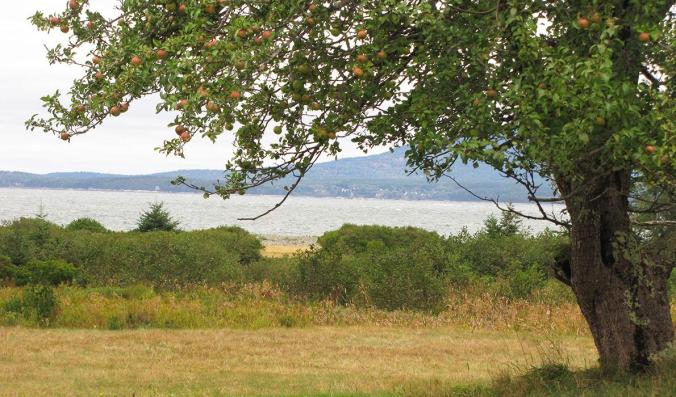
When I said I was going to write about apples Kaitlyn’s eyes lit up. “I love picking apples on the island. It’s one of my most favorite things to do! Getting outside in the fall sun, picking with a view of the water, it’s the best. And it’s free food!”

We commented on the tree filled with yellow apples by Jack and Ellie’s house on the edge of the Sand Beach.

“I’ve probably picked six grocery bags full from that tree this year,” she said. I and many others have been to the same tree several times, picking up drops and reaching the low branches to pick, with a view of the Islesford harbor.

Kaitlyn’s husband, Cory, has been making cider, experimenting with different blends of island apples. He figures he has pressed, pasteurized and preserved at least 40 gallons this year. Kaitlyn has made several batches of applesauce, adding flavor and color with rose hips from her own garden. I asked if she knew what kind of trees were around the island. She said, “You really should give Eliza a call.”

Continue reading

Apples With Special Needs

Albemarle Pippin (as we call it here in Virginia) is, in my opinion, one of the best crossover apples around. It’s great in cider, keeps well, is a wonderful fresh eating apple, and does well baked… win win win win. But its one of those apples that has special needs.

Actually, most apple cultivars have their own special needs! Yet, it seems as if these needs are only addressed in terms of hardiness (some Southern apple cultivars do not survive the cold areas of the North, for example). For this oversight, along with many other oversights I often complain about, I’m going to blame the cooperative extension service and the connected land grant university.

With the rise of land grant universities and the extension service  in the early 1900s, agriculture across the US started to become less diverse and more transportable/marketed. Extension agents, who even in 1914 were pawns of bankers, merchants, and railroad tycoons, started to spread the gospel of planting certain cultivars over others because they:

  1. Stored well (railroad tarrifs $$),
  2. Produced more annually than biennally (Merchants $$)
  3. Had less vigor
  4. Larger and more beautiful (red delicious was discovered in 1880)

Translate this into today’s time, and that’s why you have what I like to call “The Grocery Store 9”. Red Delicious, Golden Delicious, Granny Smith, Gala, Fuji, Honeycrisp, Pink Lady, Braeburn.

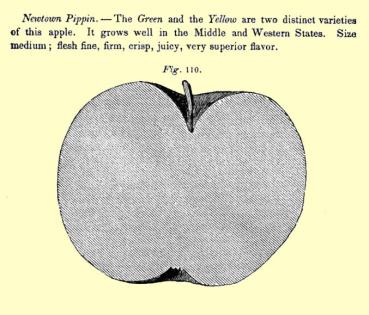
Ever since I started growing heirlooms, I noticed that some did well on certain sites while others didn’t do well at all. I noticed how in the shale dominated soils of Southwestern Virginia, the Newtown (Albemarle) Pippin didn’t do so well on its own (even on m111). After cataloging all of the Newrton Pippin diseases and doing a bit of study, I found a common denominator: there must not be enough calcium for this tree. 

If you were to take a soil test and send it off to the nearest lab with the apple box checked for analysis, they will send you something back that is meant for the grocery store 9. Not a calcium hungry-cultivar like Albemarle Pippin. If you follow their recommendations word-for-word and put down x tons of lime per acre, it probably won’t help you all that much.

This is for two reasons. 1.) The recommended amount is probably not enough calcium for this particular cultivar and 2.) The uptake of calcium by a tree doesn’t happen instantly. If you apply calcium to the soil, it will take years for the roots to get it to the fruit. If you apply calcium as a foliar spray, studies also show that it doesn’t do all that much good. So how do you get calcium into a needy tree? (Just to mention: I’m leaving out magnesium from this essay because I’m not going that in-depth tonight. Sorry, soil nerds.)

Some people recommend liming the hell out of a site before planting a tree. By the time your tree starts to hit productive maturity, the calcium will have finally made it high enough in order to be made available to the tree. Other people might still recommend the labor intensive (and often expensive) repeated applications of lime by foliar or soil (even though it doesn’t work all that well). Elaine Ingham has me thinking it could be a matter of soil microbiology, where the roots and the soil don’t have the right microbial/mycorrhizal cocktail needed for more effective uptake. (Also-the lack of soil microbiology could partially be attributed to the yearly herbicide applications to kill all grass under apple tree rows in conventional orchards). Or maybe it could be the different rootstocks? Lots of variables here to consider….and then I thought: MAYBE THIS TREE DOESN’T WANT TO GROW HERE.

Today I found this from 1864:

Screen Shot 2015-11-28 at 6.46.54 PM

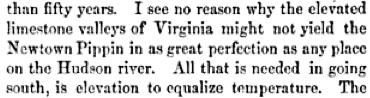
I stumbled across this article because #thefruitexplorers found one hell of an old grafted persimmon tree this month and I was looking into the history of the landowner. The landowner’s father, Yardley Taylor, was a well known horticulturalist in the area where I’m living and wrote lots of articles back in the 1800s, one specifically in answer to the complaint of: My Newtown Pippins don’t grow well here.

Yardley’s claims of “elevated limestone valleys” being the place for the Newtown Pippin makes sense. Limestone soils are rich in calcium. Where I was in SWVA, the bedrock material under the Albemarle Pippins was gneiss, schist and granite. No hint of limestone, less than ideal Albemarle Pippin quality.

There is so much knowledge left to uncover from people who once grew these cultivars in a less input-driven system. By input-driven, I mean the agriculture we know has been built on applications of outside products, often produced by large agribusiness (who funds land grant university research). What if we got back to growing cultivars that actually thrive in a specific place? I believe that’s called terroir, and it’s completely doable with apples. In order to do it, though, we may have to sacrifice low vigor, or annual bearing, or the ability to be shipped. But that’s ok… not all apples need to be for fresh eating. We’re in the grasps of a huge cider boom!  Lets keep uncovering these special needs, everyone! It’s up to us citizens to do it.

albemarle Pippin

Attention Nutri-Grain Bar Eaters

I recently discovered that Nutri-Grain bars smell EXACTLY like Nutrena’s Grower/Finisher Pig Feed (conventional hog feed). This has been confirmed by 4 other people.

I’m not at all convinced that the outside coating of a Nutri-Grain bar isn’t the same as these pellets and it would be wonderful for someone to do some investigative journalism about this. Nutrena is a company of Cargill, one of the world’s largest producers of “food,” meaning anything that can be grown using biotechnology.  Nutri-Grain is a company of Kellogg, who must source their cereal grains from somewhere…

Moral of this story: If you don’t like the idea of eating hog feed designed to fatten hogs, in bar form, I’d give up nutri-grain until you are sure.

Work Update

I realize that it has been some time since I updated this blog to reflect my current life position, which I’ve been in since January. Here it goes…

After I left Foggy Ridge Cider, I was scooped up by Severine Von Tscharner Fleming of the Greenhorns, a young farmer activist organization. She offered me a place to stay in the Champlain Valley of New York and a full diet CSA share from Essex Farm if I came and worked with the Greenhorns on a part-time basis. I accepted and that’s where I’m typing from right now.

Last year around this time, I was sitting on a porch in Virginia venting about how unhappy I was with my social life, which eventually led to me being unhappy with my place-based work. Fed up with my sob story, one of the listeners asked: “Well, what is it that you want to do?” I thought about it for a moment and then replied: I want to cultivate a way of growing apples that is low-input, environmentally friendly, and within the confines of my personal ethics. His response: “You won’t make any money doing that anytime soon. You’ve got to do something in the meantime that will make money.”

Isn’t that the plight of the young agrarian these days? Finding a means to support yourself in order to get your ideal occupation off the ground and running? For some reason, there seems to be a stigma attached to supplementing your farm business with outside income in the agricultural realm, and that has to end. Times are different now. Land is expensive or hard to come by, markets need to be created, consumer education is imperative due to increasing disconnect, and the food system is broken. Just because someone’s income isn’t fully derived from the farm doesn’t mean they are any less of a farmer. These days, anyone trying to work the land in order to grow environmetnally friendly/ethical food should be heralded rather than deemed “hobby farmer” or something to that extent. They might be working towards it, for all we know.  Heck, I could grow way more trees if I was using round-up. I could sell more apples if I sprayed harsh chemicals to make them blemish free, the income of both these options could cover my “survival income.” But neither of those options meet the goals of what I want to do/who I want to be. So, I decided to take a part-time job that met my goals and would help me and others out in the future: Farmer Activist for the Greenhorns (AKA, Director of Biodiversity)

I’m an activist because I’m a farmer who is tired of the status quo in a world where change needs to happen. Gone are the days of sitting on the agricultural periphery, wishing I had something meaningful to contribute or a way to convey my thoughts. This year, I’ve developed the confidence to use my voice and cultivated the tools necessary to bring about awareness to Americans. Poor. Rich. Conservative. Liberal…we all [hopefully] know what an apple is and can talk about one.

Speaking of apples, I’m also working with them in the Champlain valley. I’m involved with a few orchards up here, do some orchard consulting (minimal, I really don’t enjoy consulting), teach workshops, and constantly scheme about how to better my practices for the future (hopefully in Virginia).

Life is crazily busy and I am in a downright struggle to manage it all. Balance is needed, as always, and I often fight work-a-holic tendencies. But, I love where my life is right now and I am excited for every new day. That’s my update for now.

Passing of Francis Fenton, the “Apple Man”

I have just received word that Francis Fenton, the “Apple Man” of Mercer, Maine, has died.

IMG_0105

I lived with Francis when he was 96/97 years old, helping him to manage his five acre orchard of standard apple trees. He once told me that his goal was to live to 100 years old and unfortunately, he was 2 months shy of obtaining that goal. He was an impressive man in his late 90s, tall in stature, clear of mind (for the most part) and a need to go out to work for hours at a time. He asked me to call him Frank once we got to know each other better, which I only remembered to call him half the time.  He was absolutely tone deaf and would keep me up at midnight practicing the saxophone. I can still hear him practicing “When You WIsh Upon A Star,” which I knew from Pinocchio and he knew from the 40s war era. He would say: “I love that song, Liza.”

We fought about chemical use in the orchard, his argument was that it made things easy and why would anyone ever want to go back to doing hard work? He lived in a time where he watched his father work himself to the bone because without technology, there was no other option. He would make a point to show me the chain which was once wrapped around a huge rock under the barn as a reminder that the team of horses (or oxen?) couldn’t pull that one out no matter how hard they tried. After our chemical discussions, he’d say: “Oh Liza, I love technology. I’m a technological guy! I’m open to new ideas.” And then he’d ask me why I didn’t become a nurse or work at Olive Garden…you know, to get a job with benefits. He couldn’t fathom any young person wanting to go into apples and continually tried to dissuade me.

As much as we riled each other up, we loved each other. When I would leave for my other job 4 days a week (I was managing his orchard for gas money to get there, a 50 mile drive, with hopes of sharing some of the profits that fall), he would always stand in his driveway and wave goodbye, telling me that he loved me. We shared the orchard, performing different tasks the two of us felt needed doing, and often not telling each other what we did (on purpose, I think). We went on sharing until one day when we were no longer allowed to share due to a bitter and nasty family intervention. Weeks shy of harvest, I was no longer allowed to contact Francis or be in the orchard, and I went into a deep and dark depression, one where I thought about giving all of this up. I haven’t talked with him since that day he told me: “Eliza, my daughter makes me cry, too, and I’ll cry many tears over this. I’m really sorry…but there can’t be two bosses.”

He was an original fruit explorer, exploring Western Maine for old apple varieties and bringing them back to his orchard. He had around 120 varieties and his favorite was the Wealthy, which he would eat as apple sauce with ice cream on top nearly every day. His wife, who died years ago, loved Mollie’s Delicious. He always told her the name of the apple was “Dollie’s Delicious” (he pronounced it “DollieLicious”)because her name was Dollie and it was close enough. She couldn’t eat acidic foods and that apple was alright for her, he said.

I have hundreds of stories about Francis and apples that I’ll forever cherish. I’m blessed to have had him in my life and I hope he’s somewhere eating an apple out of hand. He’d often complain to me about how his dentures wouldn’t allow for such activities.

Rest in Peace, Francis (Frank)

Edit: This is part of an email I wrote back in 2012 about my experience with Francis.

On the orchard, things are interesting. It’s actually a mixture of nightmare and fairy tale, if those two could ever be combined. The orchard is 5 acres, 120 varieties, and each variety is peppered throughout without any rhyme or reason. So, this means that I have to go out with a map every weekend, document the bloom time, and try to figure out spraying. Our first apple, the charette, bloomed 2 weeks ago while 15 varieties still haven’t shown any signs of flowering. Because we’re selling apples to the public, we have been spraying fungicide weekly to kill apple scab. It’s not what I want to do, but it’s Francis’ wish so we’re doing it. I’d much rather enter into a life-long battle of trying to change people’s apple shopping habits than spray.

The fairy-tale portion of this is actually working with Francis. While living with him, I’m learning a lot about a nearly lost way of life. Since 1770, 3 generations of Fentons have lived on the property, Francis is the 3rd generation. He knew his Grandfather, who fought in the civil war and he still has sleighs that the family used to get around in the winter time. When walking through the forest, there are huge wolf trees- evidence of once farmed fields. He knows every wild thing growing on the property and we often enjoy meals of seasonal wild edibles. The past 3 weeks have been fiddleheads, or juvenile ostrich fern. There’s also dandelion greens and a few trout lillies here and there (eat the small bulb, it tastes very much like a sweet cucumber). So, we’re a good duo these days. He’s really excited that a 28 year-old female is living in his house (EVERYONE knows who I am because he announced it at church) and I’m excited about getting to know him. Chemicals or not, I’m learning a lot on the management side of things when it comes to relatively unknown heirloom apple varieties.

Workshops in NY! Come one, come all (until spots fill up)

The Home Orchard: a series of workshops with Eliza Greenman

May 9th: Fruit Tree Topworking Workshop!

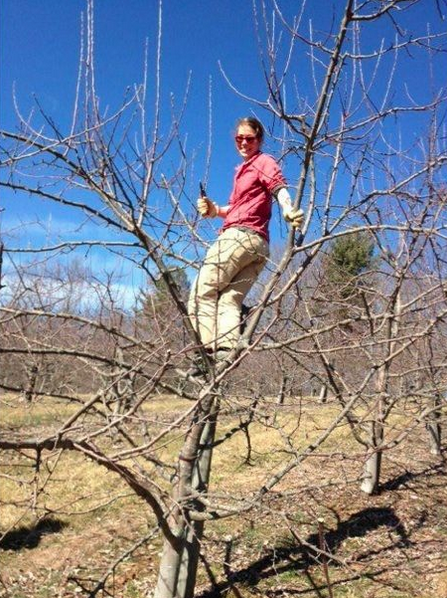
Imagine a single apple tree in the spring blooming with a bouquet of white, pink, red and purple flowers. Imagine that same singular tree with red, green, yellow and russeted apples in the fall. That tree is possible to obtain if you learn how to topwork. Come and learn the art and technique of adding different varieties to a tree. On Saturday, May 9th, heirloom and cider orchardist Eliza Greenman will walk you through the steps necessary to change an apple, pear, or hawthorne tree over to something you find more useful to your lifestyle. Whether you want to convert an abandoned orchard over to different varieties, or you are tight on space and want one of your trees to supply great pie apples for every month of the apple season…the learning starts with topworking.

When: May 9th, 3-5pm
Where: Greenhorns Headquarters: 5797 Rt. 22. Westport, NY
Cost: $15 per person. 15 slots available.
What to bring: Loppers or hand pruners, sharp knife (a single bevel grafting knife is strongly preferred), gloves
How to register: Email Eliza Greenman to reserve a spot: egreenman (at) gmail.com with “WORKSHOP” as the subject

June 6th: Growing Low-Input/Low-Spray Apples for Hard Cider

Cider apples are different from your normal grocery store apples. Not just in variety, but also in management technique. Come take a walk through the orchard with heirloom and cider orchardist Eliza Greenman to learn the basics of good and bad when it comes to growing apples for hard cider. We’ll identify and discuss beneficial insects and cosmetic diseases, concerns and triumphs in the orchard, and tips/tricks to deal with these concerns. The goal of this workshop is to have the participant leave with motivation to experiment, make observations, and join a network of people working to supple and make quality products which do not harm local ecology or the consumer.

When: June 6th: 9-12
Where: Greenhorns Headquarters: 5797 Rt. 22. Westport, NY
Cost: $15 per person. 20 slots available.
What to Bring: Notebook
How to register: Email Eliza Greenman to reserve a spot:egreenman (at) gmail.com with “WORKSHOP” as the subject

June 13th: Summer Pruning Workshop Summer

Pruning is a practice and art of addressing vigor in apple and pear trees. When practiced in combination with dormant winter pruning, a tree is able to produce more fruit and have less disease. Come learn the basics of tree vigor, how soils and winter pruning can interact with the vegetative growth of your apple trees, and how to bring the tree back into balance through summer pruning.
When: June 13th: 9-12
Where: Greenhorns Headquarters: 5797 Rt. 22. Westport, NY
Cost: $15 per person. 15 slots available.
What to Bring: Hand pruners, loppers, gloves
How to register: Email Eliza Greenman to reserve a spot:egreenman (at) gmail.com  with “WORKSHOP” as the subject

August 8th: Fruit Exploring and Summer Grafting

Learning from the landscape is one of our best tools in combating climate change and forming a more sustainable agricultural future. If you know where to look and what to look for, the landscape transforms itself into a realm of purposeful human legacies and thriving natural adaptations. Fruit Explorer/Orchardist Eliza Greenman will teach you how to track human legacy through trees, select for wild and thriving genetics, and how to propagate it all through summer bud grafting.
When: August 8th: 9-4
Where: Greenhorns Headquarters: 5797 Rt. 22. Westport, NY
Cost: $25 per person. 25 slots available.
What to Bring: Camera, notebook, single beveled knife (grafting knife preferred), footwear and clothing for walking outside, sun protection.
How to register: Email Eliza Greenman to reserve a spot:egreenman (at) gmail.com with “WORKSHOP” as the subject

September 19th: Hard Cider 101

This workshop will cover all the basics of making hard cider, from pressing to fermentation. Participants will take home a fermenting kit and a 5 gallon carboy of cider to ferment at home.
When: September 19th: 10-2
Where: Greenhorns Headquarters: 5797 Rt. 22. Westport, NY
Cost: $100 per person. 20 slots available.
What to Bring: Notebook.
How to register: Email Eliza Greenman to reserve a spot:egreenman (at) gmail.com with “WORKSHOP” as the subject

Visiting Jim Lawson, the Paul Bunyan of Bench Grafting

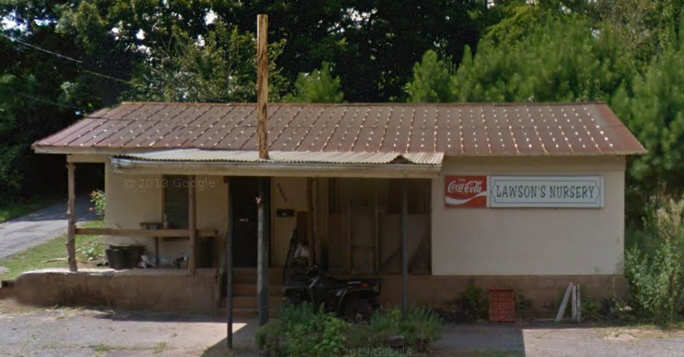
I have an apple bucket [bushel box?] list consisting of people and varieties to find before they disappear. Towards the top of my list of people to find has been Mr. Jim Lawson, an 89 year-old nurseryman from Ball Ground, Georgia. He has been credited for finding a slew of old southern apple varieties and his work has been mentioned in books, propagated by nurserymen/women across the South and planted in many, many yards. He has worked as a professional nurseryman and fruit explorer for much of his life and I just had to meet him.

Last month, I tried to go and visit a *very* old man in Illinois to talk about the nut trees on his property and an hour before we were about to leave, I received a text from his daughter telling me that he had taken a turn for the worst and was going to die. Our trip was cancelled and we never had the chance to talk with him, collect his stories, and tell him how much we appreciated him. Still feeling the sting of that last experience, I decided to embark on an impulsive trip to North Georgia to find Jim Lawson because time is running out. I didn’t have his address and my one attempt at calling him produced no answer, so I reached out to my old college roommate (Cam), who lives a town over, and we tracked him down through the local connection. If I had tried, there’s a good chance we could have tracked him down on a basis of apple tree regularity. The closer we got to his place, the more apple trees we saw in the landscape. Pulling up to the front of his nursery building, there was someone looking at us through the window. It was Jim Lawson. We had found him!

Every now and then, I spontaneously show up at someone’s house and the person I’ve set out to talk with is rather skeptical. I’ve never been turned away, but sometimes I’ve had to really work to stay. This did not happen in the slightest with Jim. He was delighted and excited to meet us.

Screen Shot 2015-04-22 at 9.53.11 AM

About once a month I run across a person who radiates an inner light. These people can be in any walk of life. They seem deeply good. They listen well. They make you feel funny and valued. You often catch them looking after other people and as they do so their laugh is musical and their manner is infused with gratitude. They are not thinking about what wonderful work they are doing. They are not thinking about themselves at all.

When I meet such a person it brightens my whole day. But I confess I often have a sadder thought: It occurs to me that I’ve achieved a decent level of career success, but I have not achieved that. I have not achieved that generosity of spirit, or that depth of character. -David Brooks, The Moral Bucket List

I feel blessed beyond words (so much so that I had to take David Brook’s words) to run across people like this in my life. They are continual examples and guiding lights for the type of person I want to be. After only spending a few minutes with Jim Lawson, I knew I had added another mentor to my registry of “people I want to be like.” The thought also hit me that if he didn’t live in Georgia, there would be a real chance that sparks would fly with another life mentor of mine, Anna, who lives on an island in Maine. They would be so cute, just the thought makes my heart want to burst!

Throughout the day, people circulated through his nursery building and with each new addition, we would be introduced as his “apple friends.” Most would come in, sit, and listen to Jim tell us stories. Some would offer up a few words but many just sat, content, until the time came when they had to go. Jim was sad when these people got up to leave and made sure to send them along with a genuine expression of how much their visit meant to him and how he hoped to see them again soon.

Jim Lawson, in the overalls, holding Adele's Choice Hard Cider from Mercier's Orchard in GA

Jim Lawson, in the overalls, holding Adele’s Choice Hard Cider from Mercier’s Orchard in GA

We talked about many topics and I’ve decided to write out the highlights rather than type up the stories word for word (they are recorded).

1.) In his hay day, Jim could bench graft (whip and tongue) 1000 trees in a day. For those of you who aren’t versed in the grafting world, this is nothing short of a legendary feat. These days, he only grafts a few trees every now and then because his hands don’t allow him to do much more. I didn’t press him for a number because I fear it’s probably in the hundreds at a time (what I do).

2.) At 89 year old, he wants to learn how to graft walnuts. So much so, that he’s going to join the Northern Nut Growers Association this year to be a part of their network and hopefully learn more.

3.) He has the “Big O” crabapple, which he will let me come and take cuttings from this summer. He knows everyone in the southern apple world and whenever someone would find or breed an interesting variety, they would give him a call. This is how he got the “Big O.” It’s a great keeper (stores for quite a long time).

4.) In addition to the “Big O,” he thought I’d really like to try the Craven crabapple. The Craven was being grown by a man somewhere in the South (again, the exact story with details is voice recorded) and Jim Lawson received some scions of this tree in the mail. He then started to propagate this tree and spread it far and wide though his nursery. Years later, he received a disgruntled letter from the old man who said that he had plans to patent the craven variety and was upset that Lawson had propagated the tree without his permission. Lawson sent him two Craven trees along with an apology and he never heard anything from the man again. Rumor has it, the man’s original tree had died and if it wasn’t for Lawson propagating the tree, it would not currently exist.

Jim Lawson then got up and walked to a back room in his shop. When he emerged, he was holding two shrunken apples: craven. He gave them to me with exclamations of how well they keep and told me to plant out the seed. My old college roommate must have been rather confused to see me get so excited about receiving two in-edible apples. I can’t wait to plant out those seeds!

craven apple

5.) In order to find old varieties, he’d just ask people. If he was driving somewhere, he’d pull over when he saw an old apple tree and knock on the door. It didn’t matter if they had names or not, if the apple was something he had never seen and looked good, he’d take a cutting and name it after the household name or address. Many of these varieties today still don’t have a true name. Sometimes, people would contact him looking for a specific apple variety and he would help to track them down given his local connections. To this day, two varieties elude him (I’ll update later on the names of these). He’s optimistic that they’re still around.

6.) One time, a man bought two of every single tree he had and planted them on a hillside in North GA. These trees have grown seedlings and are now a thriving habitat for deer. He hears from many hunters about how wonderful and appreciative they are for that planting of apple trees.

7.) He prefers to pour apple brandy over his pound cake.

When we were leaving, we gave him a bottle of hard cider from Mercier Orchards. The type of cider was called “Adele’s Choice” and when he received it, he exclaimed “I knew Adele! She would be so happy to know that they put her on a bottle of hard cider. Oh, this just makes me so happy.”

There’s really something to staying put. However does someone with insatiable wanderlust do such a thing?! I guess the answer will one day be (when/if I settle down to a single area): those people with wanderlust will just have to come and find me!

WANTED: The “Big O” Crabapple

Malus coronaria

This apple (the variety is called “Big O”) was last seen in 2006 at the USDA/NRCS Jimmy Carter Plant Materials Center in Americus, Georgia. They distributed these trees to people who inquired and have since stopped distributing. The breeding program is over and the trees no longer exist in Americus (so I’ve been told).

Screen Shot 2015-04-07 at 11.40.15 AM

DESCRIPTION: ‘Big O’ is a small tree that grows 20-30 feet tall from a slender trunk. The blossom petals are pink/white fading to whitish and the normal blooming period in Americus is mid-late March. The mature fruit is 1 ½ inches in diameter, greenish yellow and ripens in November.

Why am I looking for this tree? It’s extremely disease resistant, blooms rather late for a deep southeastern apple, and the crop matures late. It grows true-ish from seed, and the fruit itself is a larger sized crabapple.

Get in contact with me if you find this apple or knows someone who might have this apple! Just leave a message on here or find me on Facebook.

Recent essay about my trip to the national future farmers of america convention

A Report on the FFA 

by Eliza Greenman

Greenhorns, in partnership with Organic Consumers Association were in attendance last week at the national gathering of the FFA. The FFA National Convention in Louisville, Kentucky, saw a sea of 60,000 students representing every nook and cranny of America (and its territories) gathered together for fellowship, belonging, education and scholarly competition. Between the ages of 13 and 18, many of these students are next-in-line to the family farm and occupy a strategically powerful position in the future of American Agriculture; they are kids with land. With a self-confidence rarely seen in teenagers and impeccable public speaking skills, these students in their blue corduroy jackets cut quite the impressive figure, particularly in a stadium context.

They are team-spirited, motivated and articulate, and most of them credit these qualities to the organization that brought them together, the FFA. The FFA is turning these next-in-line farmers, agriscientists, ag teachers and farm sympathizers into successful leaders, fierce entrepreneurs, and good Samaritans…for Big Ag.

 This polished youth constituency at the FFA sing the praises, almost exclusively, of Big Ag. How did this happen? Lets start with the obvious place, and let’s follow the money.
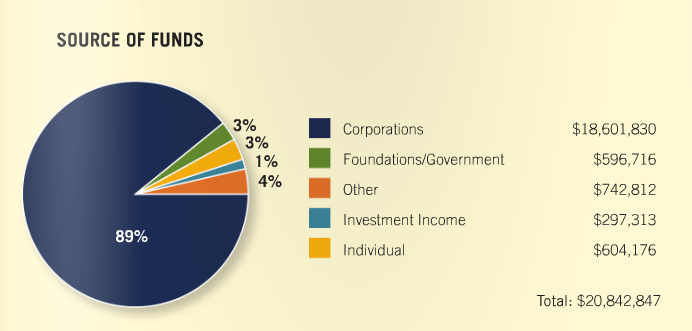
Based on the funding sources published in the 2012 National FFA Annual Report, corporate sponsorship represented 89% of total funding for the organization, or 18.6 million dollars (see page 17). This funding came from companies like:

  • Zoetis- World’s largest producer of medicine and vaccinations for pets and livestock under Pfizer

  • Cargill- Distributor of agricultural commodities such as the raising of livestock and production of feed

  • Monsanto- Leading producer of genetically engineered seed (GMO) and herbicides (Roundup)

  • Dow- 2nd largest chemical producer in the world

  • Syngenta– Biotechnology and genomic research, distribution of seeds

  • Elanco– Global animal pharmaceutical branch under Eli Lilly and Company

The corporate influence of the companies above and others were widely detected by all of the Greenhorns, as well as many of the parents and guardians in attendance at the convention. Throughout the expo, flashy, digital, draconian and utterly Orwellian interactive displays and mountains of corporate schwag beckoned students to answer the question: “Who will feed the world when it reaches 9 billion people by 2050?”

The “feed the world” sloganeering has been carefully crafted by “Big Ag” to make organic agriculture seem inadequate or even dangerous to the health of the world. The energy from the main stage resembled an arena playing Jock Jams more than an address by a CEO. Full of college football jeering, promises for thousands of future scholarships, and cheering for money (“Scream if you think money is neat-o”), students were all riled up. Tyson Foods, Elanco and Monsanto executives coached the students, with polished evangelical speeches, about the “grave risk” we face if we can’t use “technologies we have (including drought resistant seeds) to feed the world.”  Afterwards, FFA students approached the Greenhorns booth to [politely] ask us why biotechnology isn’t currently accepted by our organization. We were accused of not knowing the facts and dabbling in unethical, fear-mongering tactics (in league with Chipotle) giving consumers false and condemning information. Sweet, clean, well-meaning students explained to us why organic agriculture just isn’t realistically able to feed the world. It’s not innovative and technologically advanced enough, they said.

 Our retort: Without a return to restorative organic agriculture, our legacy won’t have a world to feed. But that’s almost besides the point. The goal is not for ‘we biotech’ to feed the world, but for the world to feed itself with foods appropriate to the culture and landscape – empowerment of communities with food sovereignty and seed sovereignty. The goal is to grow food in a way that respects the land and soil while building a biodiverse and environmentally resilient landscape that can provide us a well balanced diet, not just corn and its myriad of products. “Who will Feed the world in 2050” is a marketing tactic for big businesses that realize the destruction they are causing now, to our diets and our soil health, but don’t want to lose any market share. They don’t want to talk about feeding the world today.

To help transform the public conversation from questioning our diets and soil health towards being concerned with the future of feeding two-billion more people, companies like Monsanto are smartly investing their money to indoctrinate the FFA’s 610,000+ student member base, the next generation of agricultural leaders, their own young farmer lobby. For example, funding is being poured into extensive public speaking training for these students so their voices will stand out, even in the sensory-overloaded social-media generation. Just watch the extemporaneous public speaking finals from this year for proof of success, their stage presence is impressive to say the least.

It’s all about diversion. The keynote address from the CEO of Tyson Foods was delivered after first telling the young audience it was okay not to pay attention: don’t put your phones away, was the first thing Donnie Smith said, as he took a ‘selfie’ on stage. Instead, he ordered the young audience: “GET YOUR PHONES OUT! Let me see your phones, Louisville! Let me see them all! Light it up!” His main point, and the point of the phone gimmick was to ask the crowd to use social media to “take back” the “story of agriculture:” “These people are hijacking your story and you need to take it back!” Within hours of delivering this message with the hashtag of #myagstory, Donnie Smith’s message trended #1 on Twitter.

But, for those of us who were listening instead of tweeting, we want to know: take back the story of agriculture from whom?? Tyson Foods and others indict the organic industry, corporations like Chipotle, “basement dwelling loser bloggers,” presumably even our very own young farmers movement, have stolen the story of agriculture and distorted it with fear-mongering. These students are taught that the organic movement has co-opted the “story of agriculture” because we want to vilify and condemn America’s farmers. How unreasonable to question the farming practices of the most patriotic and hardworking of Americans. Watch these Amazing videos and see for yourself, learn the facts and know the issues, help us defend our work, help us insist on the truth.

Videos to watch from the 2014 National FFA Convention:

Tyson CEO Donnie Smith Delivers Keynote to 2014 FFA Conference

Monsanto President Brett Begemann speaks to 2014 FFA Conference

FFA introduction for Brett Begemann, Monsanto President

Extemporaneous Public Speaking Finals

 So why is Big Ag investing like this in the youth? These corporations are working towards rewriting America’s rural identity into one where hard work ethic, ingenuity, entrepreneurial spirit and family values are based, not on real relationships with the soil, land and local communities, but on the use of high-cost and high-input biotechnological innovation. Students at FFA have bought into the fairytale of Big Ag: that the best way to farm is with bigger-better-newer equipment, leasing or buying ever-larger parcels, and cultivating with high-tech seed and synthetic chemicals to ensure high yields. As one student said: “Why should I farm 600 acres organically when I can farm 6000 acres with GM products? It just makes more business sense and the world’s gotta eat.”

These bright and charming kids are getting hooked on a narrative that undermines their autonomy as business people, and gives them a shortsighted picture of farmland and soil stewardship. It is no secret that chemical inputs for monoculture crops cause serious, long-term soil degradation. It is no secret that farmers, especially those under contract with Tyson Foods and Tyson’s subsidiaries, have little control over the fates of their small businesses, where they get big or are squeezed out with crushing debt. (Read: The Meat Racket).

Given the current political and economic landscape, it would appear to make a lot of sense for young entrepreneurial-minded rural farmers to grow crops like corn because the market is demanding it (ethanol, livestock feed and export) and tax payers are subsidizing it. As farmers and advocates of diversified and specialty crops, a monoculture largely supported by American tax dollars seems to have a precarious future, yet these FFA students don’t see it that way. One feisty young man swore on his family’s farm that if subsidies were taken away, his family’s corn and soybean business would still prosper like it has been, even with the recent purchase of a $380,000 harvester. This may or may not be the case for this young man, but according to David Griswold of the CATO institute in a 2007 debate with the Farm Bureau: “Subsidized farmers are selling out their future competitiveness in the market for the sake of federal handouts.” From 1980 to 2005, cash receipts for subsidy supported crops like corn, soybeans, wheat, sugar beets, etc rose 14 percent while cash receipts for non-supported crops like fruits, vegetables, and nuts, soared by 186 percent.

We have reached a moment where the mainstream American public has begun to question the contents, supply chain, ethics and health of their food supply, and wants it labelled. Big Ag is getting worried. Last fall the “Farmers and Ranchers Alliance” paid for and distributed a ‘documentary film about young farmers in America,’ called Farmland. This film was distributed to Farm Bureaus across America in order to hit their target audience of sons and daughters born into conventional agricultural families who feel squeezed and misunderstood by mass media depictions. Outside of the Farmers and Ranchers Alliance’s reach, this film was dismissed as an elaborate high-cost puff-piece (“more like a feature-length advertisement than like a documentary”). Many students we talked with asked if we had seen this film, which they felt was a fair portrayal of their lifestyle.

Through millions of dollars in donations, corporations have created a heroic strawman, an all-American, football loving narrative painting themselves as saviors of global hunger and harbingers of sustainable agriculture. This heroism gets piped into rural schools right alongside the pledge of allegiance, beckoning student farmers to join them in their effort to intensify production in order to meet growing food demands. The rewards are big and the conventional way of farming is seen as a sure thing for right now.

The national FFA conference was best summed up by Greenhorns teammate Katie Murray: “These corporations and FFA mindsets are in-put, output driven. These students aren’t being taught to think of the long-term effects. They are a rising generation of agricultural thinkers and actors who aren’t considering the whole system.” Feeding the growing population, 9 billion by 2050, is just a piece of the whole-system puzzle, including our diets and soil health today, in 2014. The FFA is built on camaraderie and relationship building, yet it seems to fall short when considering the ecological relationships needed to sustain this earth for centuries to come. This is a disservice to the members of the Future Farmers of America, who deserve to learn and be exposed to more than what the current educational constraints dictate.

Can we feed 9 billion using organic techniques? This UN report says its the only way forward. In order to further this train of thought and practice, we’re going to have to invest in relationships with the incoming generation. The FFA students are smart, friendly, respectful, hard-working, down to earth, and completely insulated by the FFA curriculum. It’s our job to help them to make more connections with a more diverse nature and expose them to the way of life we believe in. Reach out to your local FFA chapter and see what you can do to help. Volunteer, offer guided tours, be a guest speaker and get to know these students clad in blue corduroy jackets. They are good kids, and we’ll need them on the team.

In the words of William C. Gehrke, who as farmer-teacher-advocate in 1936 wrote a letter published in The Kansas Union Farmer about “a better way to get farmers to realize social problems“: If the common people would awaken, especially your farmers, shake off the shackles of ignorance and quit following blindly, you would become master of your own destinies. Let’s learn from this history and stop teaching ignorance.

(This essay has been taken out of the most recent Greenhorns Eblast, which can be found HERE)

This article was also helped and enhanced by the editing talents of Severine Von Tscharner Fleming, Ann Marie Rubin and Anna Isserow. .